

(2) 219 N. Cloverdale Blvd. A workhorse among local business buildings, this simple false front structure is the second oldest commercial building in Cloverdale. Built in 1875, it housed Shaw Mercantile and was the site of the Post Office and Express Office until 1879. It then became home to the Cloverdale Reveille which had been in continuous operation with the same name longer than any other weekly newspaper in California, up to the late 2010's. Throughout the years it has housed a number of businesses including two jewelry stores, several restaurants, Photographix, Low Knob Press and Bolt Fabric and Home. This building is listed on the National Register of Historic Places.

(3)
(4) 241 N Cloverdale Blvd. This home, popularly known as the doctor's house, was built in 1903 for Dr. Charles F. Grant, who also set his medical clinic in the home. The house continued as a doctors' residence and medical office for decades. Doctors who practiced in the home include Dr. Grant in 1903, Dr. Shipley in the 1920s, Dr. Wheeler in the 1930s, Dr. Sohler in the 1940s, and Dr. Greenhalgh up to the 1960s. The upstairs of the doctor's house also served as a small hospital established by Dr. W. Shipley during the 1920s.
(5)
IMAGE HERE
(6) 325 N Cloverdale Blvd. This Victorian Cottage, built before 1884, was the home of early physician Dr. Markell. William "Pop" McCray who developed the famous Old Homestead resort in the 1900s, also lived in this home. The popular Old Homestead resort spanned over a quarter century and could accommodate over 300 guests who flocked to Cloverdale to bathe in the Russian River. Note the gingerbread trim, double doors, and stained-glass windows.
One of the attractions for guests of "Pop" McCray's Old Homestead resort was the beach and activities along the Russian River.
(6)

(8) 427 N. Cloverdale Blvd. This is a Dutch Colonial, built in 1926 for Elizabeth and Emily Dineen. Elizabeth and her husband owned Dineen's pharmacy and she managed the pharmacy after his death. Elizabeth and Emily ran a poultry ranch on the property. Elizabeth was a charter member of the Women's Improvement Club and owned the Cloverdale cemetery until she deeded it to the city in 1932. Note the upper roofline and front columns as well as the original windows.
(8)
IMAGE HERE
(9) 435 N. Cloverdale Blvd. The first house on the property, built before 1872 for Col. J. B. Armstrong, burned down and was replaced in 1884 with the present house. Col. Armstrong helped organize the first Citrus Fair in 1893.
Armstrong Woods in Guerneville is named in his honor. Called the Armstrong House, it was an art gallery before once again becoming a private residence.
(10)

(11) Kleiser Park. This plot of land was donated by Cloverdale's founder, Mr. Kleiser in 1860. It housed the elementary and high schools between 1864 and
1958. Initially a log cabin with a stone fireplace, the Cloverdale School was replaced in 1864 with a two-story wooden building. The school was built in 1917. The gray stucco was considered quite modern at the time. The land was developed as a park by the Women's Improvement Club and dedicated to the memory of James Abram Kleiser in 1963. Community members have bought memorial bricks that are placed throughout the park. Stroll through the park to see if you can find the Kleiser dedication.
(12)

(13) East side of N. Cloverdale Blvd. As you walk down this block you see evidence of rebuilding in Cloverdale. Many of the houses on this block were moved, burned, or were torn down with new buildings constructed in their place.
One example is the Chalfant home built in 1860. In the 1960s, it was moved to 4th and Main. Piacere restaurant occupied this site in recent years. The 1890s Brush home on the right, became the site for an A & W Root beer stand and then the Fred Young Mortuary.
(14)
(15)
(16) 204 N. Cloverdale Blvd. Though not historic, this building houses the Cloverdale Arts Alliance and an exhibit from the Cloverdale Sculpture Trail can be seen on the sidewalk in front of the gallery. Drop in to view art by local and guest artists, find out about live music in town, and pick up a brochure for the Cloverdale Sculpture Trail, or check www.cloverdalesculpturetrail.org.
(17)

(18) 124 N. Cloverdale Bld. Cloverdale City Hall was built in an Art Deco style in 1936 during the Depression by New Deal workers as part of the federal Works Progress Administration (WPA) program.
Cloverdale Blvd. North Loop
(1) 215 N. Cloverdale Blvd. The Gould-Shaw House was built in 1862-1863 by Thomas Gould. It is the oldest documented dwelling in Cloverdale and one of the rare surviving examples of Gothic Revival, an architectural style of the Victorian era characterized by steeply pitched roofs, pointed-arch windows, elaborate trim along roof edges, and high dormers. The house was made from locally manufactured brick, hand-made square nails, and decorative wood cut by a then newly perforated saw which you can see in the History Museum. The façade appears today much as it did in the 1870s. The house was purchased in 1875 by Cloverdale pioneer Isaac Shaw, the first president of the Cloverdale Banking and Commercial Company. The Cloverdale Historical Society purchased the house and property in 1983 and undertook a major renovation and retrofitting in the late 1990s. The Victorian Cottage Garden was planted using vintage plants in the area when possible. The garden was dedicated to Mae Gibson Foster by her son in 1989 in memory of his mother and Mrs. Shaw sitting in the original garden. The Society and Green Thumb Garden Club maintain the garden which includes an orange tree that was planted more than a hundred years ago. This house is listed on the National Register of Historic Places. Come visit the History Museum and tour the house to see how it may have looked in its early days.
(1)

(2)


(3) 227 - 233 N. Cloverdale Blvd. In the 1930s this building housed the Orpheum Theatre, which featured stage plays as well as films. It has since been the site of several restaurants and a donut and coffee shop. To the south at 229 N. Cloverdale Blvd. was a two-story building that was the site of the first two Citrus Fairs in 1893 and 1894. The building burned down in 1909 and was rebuilt in 1920. It served as a furniture store and at the same time, a mortuary and funeral parlor, both run by California's first female mortician, Edna Cobb Gordon who also gave violin and piano lessons and was a dance instructor.
This block has been a variety of businesses throughout the years, including Plank Coffee and 14 Feet.
(4)

(5) 119 W. Third St. This house was built of redwood in 1879. The second floor of the building was a dormitory for the nurses who worked for Dr.
Shipley's hospital. Later in the 1940s, Dr. Clark repurposed the house as an emergency hospital. There was a coffin on one of the side doors to indicate that the dead should be carried through that door rather than through the front door.
This location once was a Bed and Breakfast and is now a private residence. Note the wrap around porch with traditional gingerbread trim.
(6)

(7) 401 N. Cloverdale Blvd. James A. Kleiser and his wife Elizbeth lived in the home pictured here in 1869. The home was empty for a period of time, became a rental in the 1960s, and was torn down in the 1970s. The Cloverdale Library was built on this site.
(7)

(8)

(9)
IMAGE HERE
(10) 439 N. Cloverdale Blvd. The original Congregational Church, the first known church building in Cloverdale, was built in 1869 at the cost of $2,500 on land donated by James Kleiser. In 1906 or 1907, the original church structure was moved back from the street and the new sanctuary built onto the front.Two large windows of leaded, stained glass were made specifically for the church. These have orange branches, leaves, and oranges reflecting Cloverdale's nickname as the Orange City. The church's pipe organ was powered from a Pelton wheel connected to the city water system. According to church member Emma Sedgley McClelland, when the local water wagon tank was being filled, the water pressure would be reduced, muting the sound of the organ. The Congregational Church became the United Church of Cloverdale in 1979 when it joined with United Methodist. The United Church, also known as "Ivy Church", was famous for its brilliant colors each fall. The Boston ivy was planted in 1910 by E.A. Cooley. The ivy was later removed because it destroyed the wood shingles. Note the use of river rock and the ornate redwood shakes around the windows and the door. The church is the most photographed building in Cloverdale.
(11)

(12) 521 N. Cloverdale Blvd. This farmhouse was built in the 1890s and was the home to several families throughout the years. Originally this property was 13 acres. Eventually, part of the land was annexed by the city, leaving the home with half an acre. The land on which the high school is built was once part of this farm. The home has been extensively renovated inside and out with each renovation reflecting and respecting the style of the original structure.

(13)

(14) 324 N. Cloverdale Blvd. This home was lived in by Mr. Sanders and his family in the 1950s.
The home was renovated in 1971 and became a service station. The building was purchased in 2018 and was again renovated, this time as a realty office and home. Note the gingerbread trim and river rock used for the foundation.
(15)


(16) IMAGE HERE
(17) 134 N. Cloverdale Blvd. On this corner once stood a grand two-story hotel built around 1860 out of native brick. The United States, or the "U.S." Hotel, served as the stagecoach stop and ran its own stages to the train depot. The popular hotel was renovated in the mid-1940s only to be destroyed in 1947 in a spectacular fire. This corner also was the site of Dick Maio's Texaco Service Station in the mid-1950s and later the Lockhorn bar and restaurant and then the La Hacienda restaurant. The famous pair of preserved deer who died with their horns locked in perpetual battle were once on display at the La Hacienda bar, later named the La Tequila Restaurant.
(18)


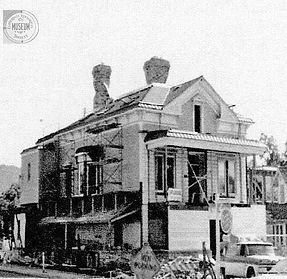
(15) 210 - 240 N. Cloverdale Blvd. This turn of the century house was built in 1864. It was raised 13 feet in the 1980s by developer Tom Dean, who transformed the building into a colorful creation with copper roofs and twisted brick chimneys. John and Terrie Spenst bought the property in 1988 and completed the renovation of the building. The set of buildings directly south, once housed the Clover Inn. They also were transformed as part of the Copper Towers project. The Copper Towers have been a medical complex, health center, and art gallery. These buildings continue to house several businesses.